Otomo and Movement in AKIRA
One of the first things that comes to mind when I think of Otomo Katsuhiro is motion and flow. I think Otomo's mastery of capturing cinematic motion inside still pictures is one of my favorite parts of his work. Every panel you see is like a snip from a film reel. If you put the pieces together quickly enough, you almost get glimpses of animation.
Otomo has been open about film being a big inspiration for him. He has referenced films many times in interviews of his. It's no wonder he would approach and treat illustrating his comics as a director might go about mocking up shots for his film.
Good comics are meant to tell a story in some order, and you have to achieve a satisfying flow to tell that story properly. I guess that's an obvious rule of comics, but I want to take a moment and appreciate Otomo's skilled understanding of this principle. While his ability to illustrate satisfying pages is apparent in all his work, I wanna analyze the flow of a few specific pages from AKIRA.
First page I want to take a look at is page 206 from Volume 1. This page is simpler. There's no fighting and no bombastic movements. The only person to focus your attention on is Kaneda. But the use of motion, how your eye naturally follows the panels from right to left, is one of the best examples of Otomo's cinematic style even in less intense moments.
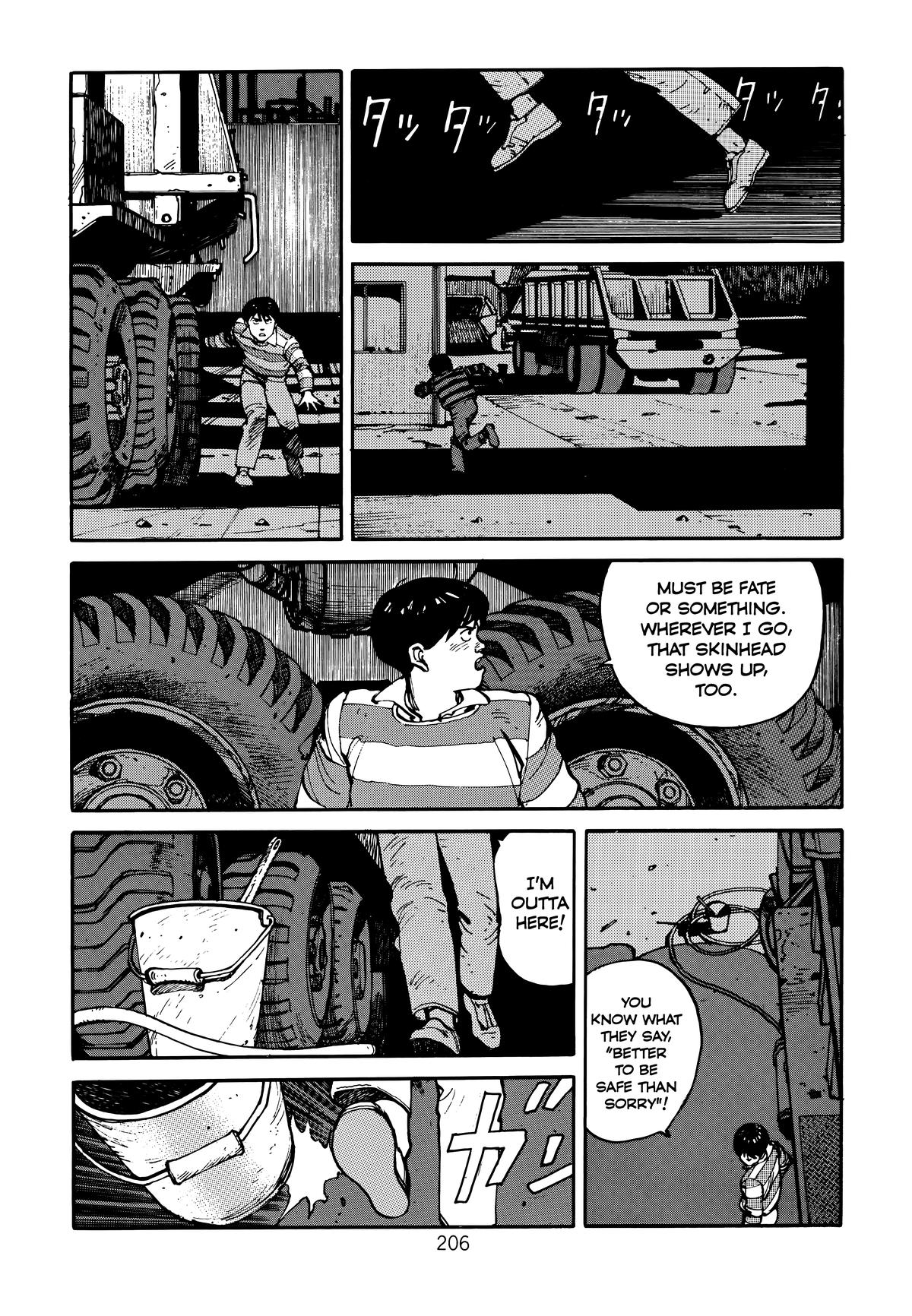 The page before this was a different scene between the Colonel and some soldiers, so this page is like a hard-cut back to Kaneda sneaking around on the Olympic site. Actually this section of the book switches between a few different scenes happening at once.
So Kaneda runs in from the right, first panel, and the second panel below cuts to a wider shot of him running across an open area. You can almost feel him dip in and out of shadow as he weasels around. Then this motion comes to a rest with him stopping by the truck.
Now he talks in a closer shot in front of the truck. What's interesting to me is the subtle shift in perspective. It's not all that breathtaking but... The previous panel was in front of him, looking head-on, creating this sense of drama (in his pose and framing beside the truck) and finality to the motion of the first two panels. Now the "camera" has cut to a medium close-up, and he's turned around to make his comment. It's a nice reset for the eye bringing the "camera" back in.
Where it gets good for me is the next panel. It's very simple, again, nothing so interesting is happening in this whole page, but the 5th panel leads your eye down. Never mind the fact you might see the next couple panels out of the corner of your eye, panel 5 sets up the "joke" before it happens. Your eye comes down from the bucket to Kaneda, like you draw this invisible line of cause and effect.
You already know the idiot isn't paying attention, you feel it coming, and panel 6-7 give that resolution of him walking up to and kicking the bucket. Simple but really effective.
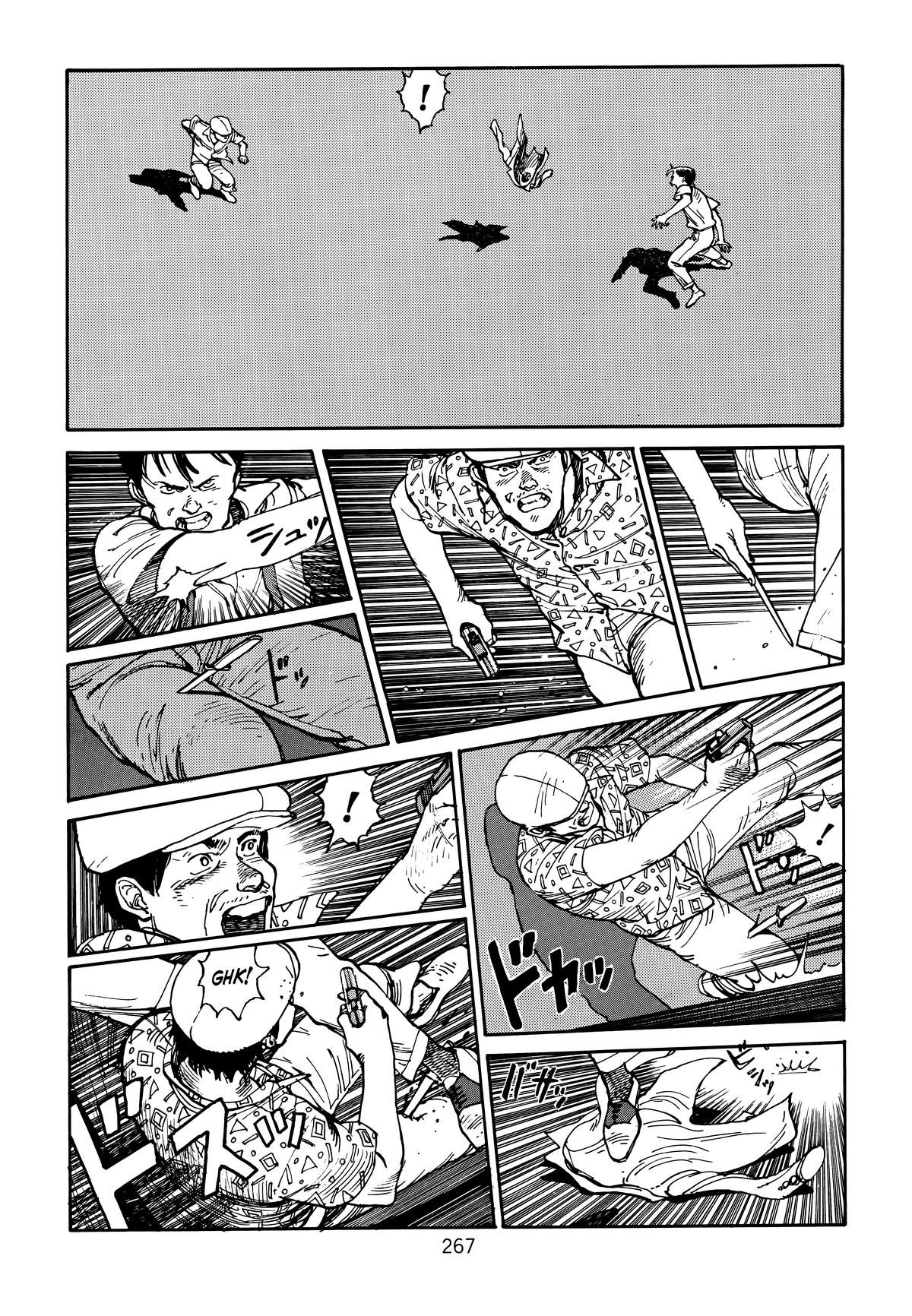 Page 267, also from Volume 1, is more dramatic. It's the first fight between Ryu's friend and the government spy. The opening panel feels like time has stopped before the fight starts. Already it's way faster in it's motion, many shots coming one after another to convey this sense of speed and tension. Each man pulls his weapon, cut, cut, cut; the whole page is moment-to-moment.
Your eyes snap from one image to the next, like every second can't be wasted in who makes the first move and wins the fight. Where as the previous page, 206, felt more slow to the motion of the eye, this page is very sharp. If I had to draw a line along where my eye goes to next, it would be angular, following the corners of the panel borders.
Each varied angle and close-up provides a clear image to what is going on in the chaos of the fight. Ryu's friend's close-up in panel 8 right before he gets knee'd in the stomach is perfect to create a short pause in the action to see this man's face. You, and him, know what is about to happen. This page is really exciting.
I have way more favorite panels and pages I could list here since I could talk about AKIRA forever. But I want to end with a catastrophic page. These two examples I've shown because I wanted to give a look at how Otomo uses motion between action sequences with people and not. No matter how tense or relaxed it is, things are always moving. Everything is very natural. It's always interesting and varied.
Nothing less can be said when it comes to Otomo taking no shortcuts to show the reader total destruction. The final pages I wanna look are from Volume 3.
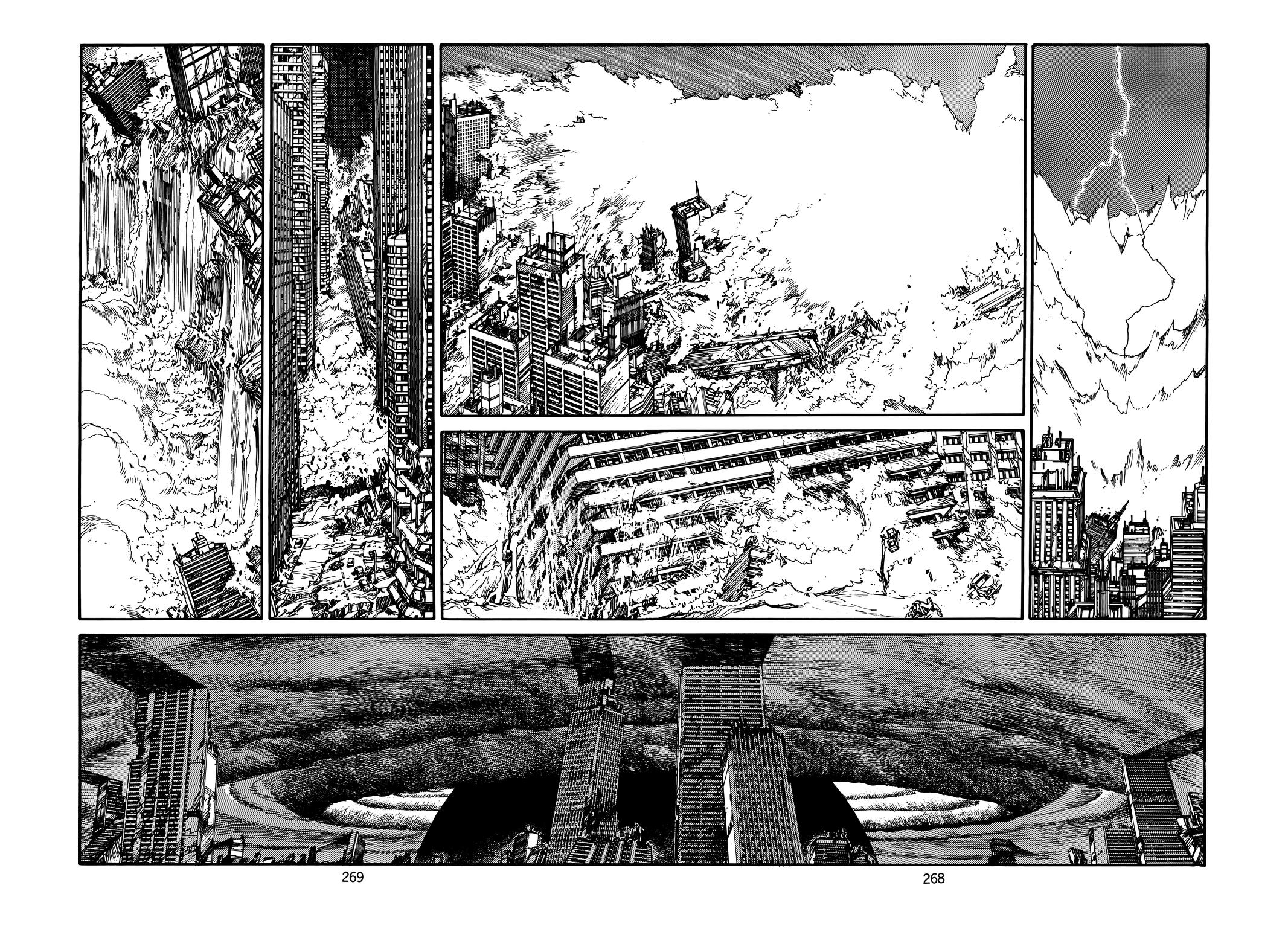
Page 268 and 269 aren't the most famous from this book or this event, but I think it has excellent use of movement and flow using the subjects of the panels. So much is conveyed in this entire scene without showing a single person during the destruction. Aside from the Espers, Kaneda, Kei, Chiyoko, the Colonel... I always remember that page in the middle of Akira's reawakening, the ones showing all the people unaware of what's about to happen.
In the first panel, your eye comes down like the lightning does. It moves back up with the rush of water to the second, following the waves in almost the same crashing pattern, down to this cramped shot inside the city as the flood crushes and topples buildings. In panel four, your eye is drawn down again, following the rush of water through the streets. Buildings fall. Panel five, it follows the end of the flooding water into this big artificial lake being created.
Everything culminates in the last panel, a very wide shot looking up at the singularity. Since it's a spread, I think you can look at it from left to right and still feel the motion. You can feel the wind swirl and the shadows cutting the sky. It's terrifying and larger than you can imagine. Otomo has brought everything down so you can feel the weight of this disaster.
How does he do it! I always ask myself that, as a pretty amateur artist. You get blown away by his work it's hard to wrap your head around it. It's easy to think that someone like Otomo didn't have to practice this work, that it's just this innate talent he was gifted that came through. His art must have always been perfect from the beginning. That's not true.
Otomo was an amateur once. Only through his exposure to many mediums of art-- film, writing, comics-- was he able to really understand and make for himself his own style of manga. He had to learn to become a master.
His placement of objects and people within each panel of his comics are carefully selected. He isn't just putting characters over white voids all the time, nor half-assing the details in his backgrounds or mechanics (and much appreciation to his assistants as well). He puts care and thought into the motion of his stories, leading to amazing pages-- even if the subject matter isn't always dramatic. He draws comics that feel alive, and it's easy to get absorbed in that as you read them.